 |
 |
 |
 |
 |
 |
 |
 |
 |
 |
 |
 |
 |
|
The Curious, Absurd and Delightful! Little Things that Caught my Attention
The purpose of the page is to share with you incidents, people and situations that I have come across, mostly on my motorcycle meanders, that have struck me as being either curious or, at times, even absurd or, more often than not, simply delightful. Burgers or Burghers
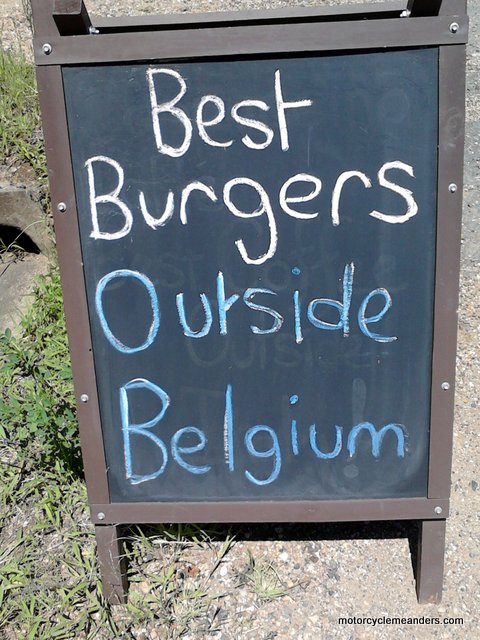
Having come across allusions to burghers in many historical contexts (they were many across Europe – not just Belgium, the sign got a responsive reaction from me. There are, of course, many references in Belgian history to the Burghers and their fights with the populace. The term is used in several contexts and has slightly different meanings. In the Belgian context it referred to a class of citizens from which usually town leaders (town councils) were drawn. Hence fights with the populace. I thought it a bit obscure to have this sign in such a place as Wallabadah. Indeed, it’s a bit obscure in any event. Some friends to whom I showed the picture were not sure what the point was. However, it tickled my fancy. Measurement Gone Mad Even when the technocrats get the spelling correct (cf. items below on metres and meters), there’s still cause to wonder about their sense of practical measurement. No, perhaps that’s not quite fair. After all, measurement is measurement. Hence, as someone who once dabbled on the margins of metrology, I can readily accept that, if someone posed the query of the time taken to cycle or walk a distance of x km travelling at a speed of y kph, then the answer (in minutes) would clearly be x/y x 60. It would be in the best interests of measurement accuracy to provide the mathematically correct answer – even if rounded up to make more practical sense. But what if the purpose of the exercise was just a little less than rendering mathematical accuracy and telling tourists something useful and practical about how long it might take to leisurely walk or cycle various distances around Canberra’s Lake Burley Griffin? Australian Capital Tourism has very generously and constructively placed several signs around the lake to A lot of the walking times are in excess of an hour. That’s fine. But how helpful is it express the hours as a decimal number? There’s always been a joke about time going decimal to follow decimal currency and metric measurements, but most of us thought it was a joke. Not here. The signs tell you that it will take 1.3hrs to walk to Weston Park; or 1.4hrs to walk to the Arboretum; or 3.2hrs to the Parliamentary Zone. Even cycling wins a jersey in the decimal stakes. From a particular spot, it’ll take you 1.1 hours to ride to the Parliamentary Zone. Mercifully, the numbers have been rounded up to one decimal place! Just quickly, pretending you’re a tourist on a warm day with kids in tow and ice creams spilt, how many minutes are there in 0.1 of an hour or 0.3 of an hour?
That anomaly aside, there obviously have been some productive flexibilities in the metrological calculations so that what might have come out as 49 minutes (on the basis of the seemingly adopted kph figures) has been rounded up to 50 minutes. I guess 49 minutes might have seemed a bit too pedantic for a cycle ride of 13kms. Some relief! However, not all timings – or even distances – fared so sensibly. We’re told it will take 21 minutes (yes, 21!) to cycle 5.3 kms to Weston Park. There are some signs which clearly indicate the calculations are based on 16kph for cycling and 4kph for walking, while 15kph seems to be the basis for some other cycling calculations. All fine starting points. So why come up with 21 minutes? Was it rounded down 0.2kph on the basis of 15kph? If so, why not round the 19.9 minutes (that a basis of 16kph would have delivered) to 20 minutes? Similarly, it’ll take you 21 minutes to walk the 1.4 kms to Commonwealth Park. That’s walking at 4kph all More Meters I have previously lamented the adoption of American spelling for the simple term we use to capture the length of the path travelled by light in a vacuum in 1⁄299,792,458th of a second. The term is, of course, a metre. The definition used to be much simpler, namely, one ten-millionth of the distance from the Earth's equator to the North Pole (at sea level), but advancements in metrology have rendered the current definition (opting for laser measurement over physical artefacts). Never mind, a metre is still a metre! Unless you’re in America, where it’s a meter.
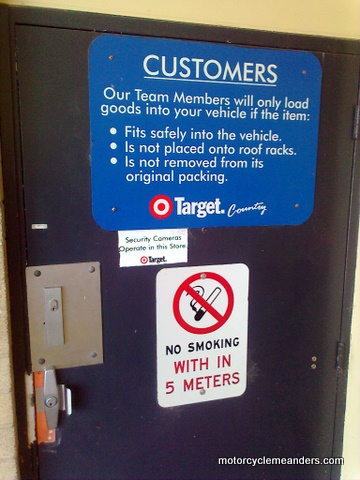
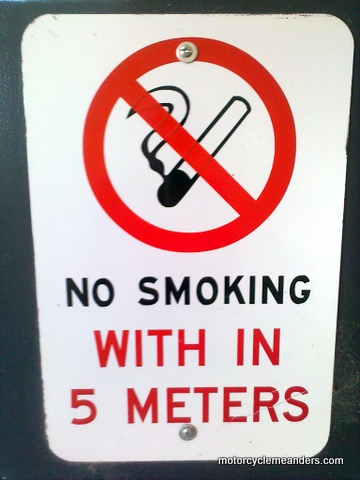
Several items below there is one headed “Meters Galore” poking a Not only are we told there’s no smoking within “5 meters” – at least I think that’s what they were trying to say. Not that I could spot a single meter anywhere in sight. But we are told the no smoking applies “with in” “5 meters”. I simply can’t get my mind around what the two-word phrase “with in” conveys in any grammatical sense. One could produce a book of grossly incorrect signage. I keep wondering who’s to blame. I think it’s unfair to dump on the sign writer. He or she is presumably just reproducing what been given them by the supposedly better informed purchaser (such as the Mackay Council or Target Country). Phallusy or Not? You might think this a classic fallacy; but it’s not so in Buddhist tradition! In Bhutan – during the Shangri-La tour – we came across so many instances of the classic phallus looming in front of us. And, no, it wasn’t a case of a love-sick or sick-love society. In Buddhist tradition, the phallus is regarded as protection against the evil of the slanderer. The slanderer is regarded as a most harmful enemy that can wreak irreparable havoc. However, on seeing the phallus, the slanderer is forced to slink away, shamed by the very sight of the phallus. Hence, the slanderer avoids the places where it appears and bothers not the inhabitants. I was convinced. But they did take some getting used to. As an aside, note this extract from a website Digital Tibetan Buddhist Altar: The entire history of Tibetan Buddhism is absolutely strewn with accounts of vile slanders. To take just a few examples, King Indrabodhi was slandered, Padmasambhava was slandered, Vairotsana was slandered, and King Trisong Detsen was slandered. In our own time, Tarthang Rinpoche was slandered, Trungpa Rinpoche was slandered, Kalu Rinpoche was slandered, Lamasang was slandered, Sogyal Rinpoche was slandered, Sakya Trizin was slandered, and the Dalai Lama is slandered on a daily basis.
Watch Your Head! Motorcyclists aren’t necessarily noted for being tall. So many of our champion Superbike and MotoGP racers are, in fact, quite small The Kosciuszko Chalet Hotel at Charlotte Pass in the NSW Alps dates back to 1938. It’s referred to as the ‘the grand old lady of the mountains.’ Its basement looks like it was built from hand-cut blue stone – and probably was, given its vintage and inaccessibility. I guess the designers, builders and labourers of the day weren’t into allowing too many luxuries, so the arched walk-throughs were kept compact. By today’s standards, they wouldn’t get building approval, but no doubt they are all heritage listed now.
Sheep Introductions? One can only guess at what it is trying to achieve beyond the immediate, short-term, if enigmatic, objective of having ‘sheep introductions’ reported. Perhaps it comes down to our Defence dollars at work for the national benefit! Rumour has it that, deep within the Defence establishment at Russell (ACT), there is a top secret unit dedicated to the preservation of national values against onslaughts from foreign agents provocateurs. It seems that there have been ‘intelligence’ reports to indicate that New Zealand fifth columnists, inspired by the publicity given to perceived needs to ‘find the farmer a wife,’ have infiltrated Australian
I did wonder about the sign I passed while making my way from the High Street (as they love to call the main street of any town in the UK) back towards Kirtling. It did seem at first glance to be differentiating between a regular police station and this special ‘long stay’ one, presumably, I thought, for the more recalcitrant offenders. Tables Turned
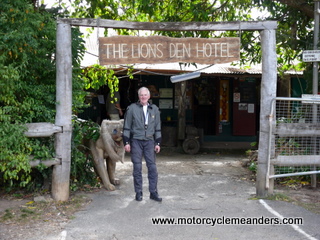
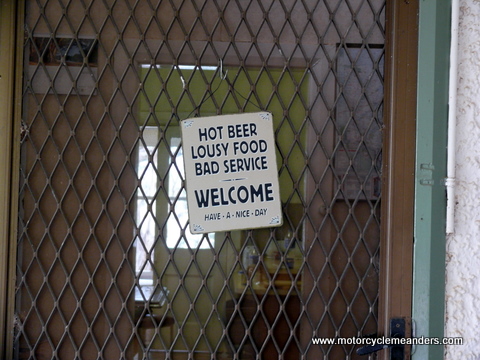
The Lion’s Den Hotel is just one of the many curiosities you can find in FNQ. A Welcome Welcome at Kulcurna Homestead
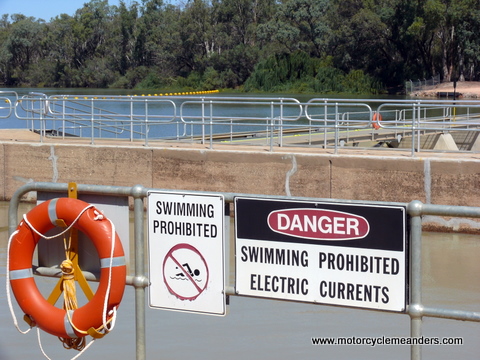
I was an invited guest to Kulcurna, but by the time I arrived I was a distressed soul lost in the wilderness, much the same as might have been many wanderers of old. To have reached Kulcurna, in the fateful circumstances in which I was thrust, was such a relief that the welcome sign, curious as it might seem in isolation, was like a desert mirage that suddenly transformed itself into a cool, sparkling waterfall. Everything it offered was begging to be enjoyed. And it was. An Outcome of the Drought? Now, you’d imagine that, with the combined forces of both rivers, there would be enough pressure to maintain a natural current through the weir and lock. So why would they need to supplement it by an artificially generated electric current? I hope the electricity, at least, is hydro-generated!
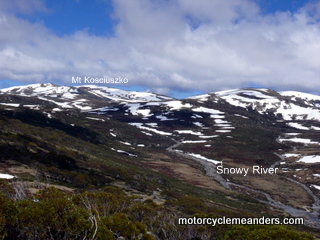
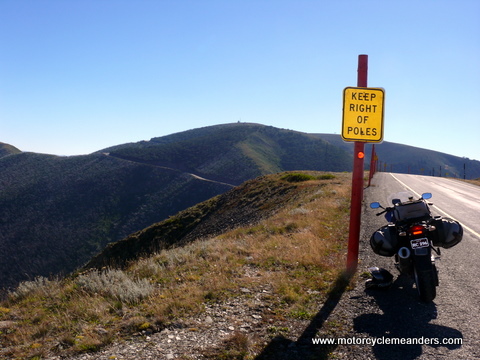
In fairness, however, the road does get snow-covered in winter (it’s close to 2000m here). That’s also why the lines are painted yellow instead of white, as they are everywhere else. Yellow in snow catches the attention. Snow also tends to blur the edges of the road and the too far point of the top of the drop-off. So, it’s a useful admonition – to be well heeded – to keep right of the poles! J….
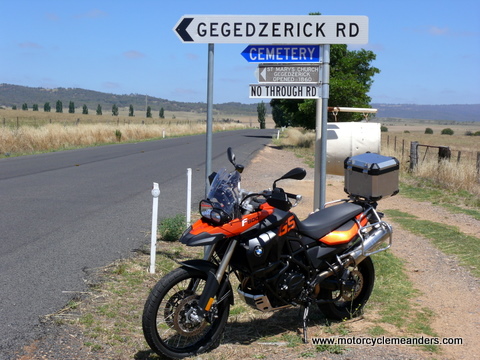
For Christians, over the centuries, the options were Limbo (permanently), Purgatory If you’re a Muslim, I understand, you will be rewarded with so many virgins. Or is that only if you’re a martyr? I’m not sure how female Muslims would feel about that – especially the female martyrs. But, then, of course, there are male virgins. After all, I was one for 24 years. So the female Muslim martyrs might have something to look forward to. I don’t know enough about the Asian religions to comment further about what their followers might expect is in store for them. However, let's get to get to the real point of this item, namely, where do the the civic and ecclesiastical leaders of the NSW town of Berridale stand on the eternal (or otherwise) conundrum?
So, it doesn’t matter if you’re Jewish, Christian or Muslim, if you die and are buried in Berridale, there simply is no through road to take you anywhere! Sorry!
Well, that’s what I assumed. My Concise Oxford Dictionary tells me that providence means “1 the protective care of God or nature. 2 (Providence) God in this aspect.” It then tells me that portal means “a doorway or gate etc., especially a large and elaborate one.” This is surely a sign pointing to the Gates of Heaven! So don’t let yourself feel despondent by the previous item. It doesn’t have to be the end of the world.
But there’s no deception or misleading of the buyer here. You know you’re getting the real thing. This guy’s fake watches are genuinely fake. That’s guaranteed.
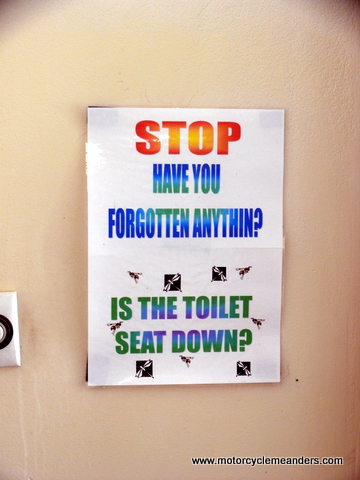
Ah, well. There’s more to it. It seems they have a huge mosquito problem. The little biters must like to muster in the water in the toilet bowl. It’s not the seat so much as the lid that has to be kept down to keep the ubiquitous mozzie out. Notice the mozzies on the sign! The Mallee lands of Australia are a vast tract of scrubland extending from Western Australia across South Australia into northern Victoria and south-western N.S.W. The Mallee encompasses almost a fifth of the land mass and comprises one of the main ecological systems that dominate the continent. It’s a multiplicity of interlinked environments, harbouring more than 700 distinct plant species, 400 kinds of birds and countless animals and insects. (Threat to Mallee Lands) One of the threatened species is the Mallee Fowl. I think you must pass through one on the road to Mildura. There are signs indicating breeding areas; and there’s the one in the picture! It had caught my attention a few times as we rode to and from a couple of Ghost Town Rallies in Broken Hill (NSW), but it hadn’t been convenient to stop and take a photo. However, on my recent Big Trip North – day 2 – I made a point of stopping.
I hope the Mallee Fowl appreciate the work that has gone into their rest area. Meters Galore!
The Mackay City Council (Queensland) is certainly taking it all very seriously. This sign, one of several, is in the Mackay Botanical Gardens. I spotted it during my Big Trip North. I wasn’t sure of the precise message. Was there some ratio linking the number of meters and the number of steps? Steps to what? A resolution to climate change? So, at the point of the sign, there are still 2750 steps to the end point; and 1925 meters will be needed. Then, again, sitting in the shade of a wonderful, traditional, Islander-inspired meeting So, did Mackay Council really intended to have said ‘1925 metres’? That would make more sense. A quick use of my calculator told me that there was an explainable and credible ratio between 2750 steps and 1925 metres. One step equalled 0.7 of a metre. A bit small, especially for Queensland, where everything is bigger than the norm, but a reasonable reflection of the average tourist’s ambulation pace. Plea to Mackay Council: please make amends – to the Public, to the rate payer and to the English language. Three Turkish Muslim Young Women
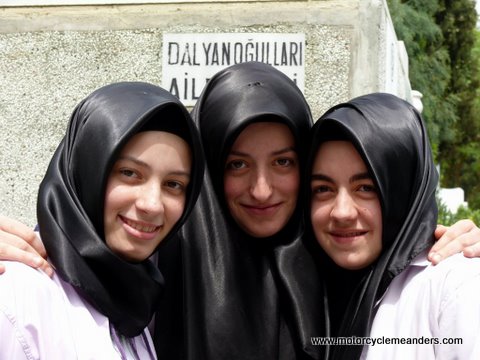
I suspect neither Christians nor Muslims outside Turkey have any realistic appreciation of the historical, cultural or religious history or dynamics that prevail in modern day Turkey. Even some Turks have a problem with these issues. Anyway, the point of this snippet is to capture the attitude of three ‘random’ young Muslim girls wandering through the cemetery of the Eyüp Mosque way up the Golden Horn in Istanbul. I ran into them during my Turkish tour in 2008. As I was making my way from the Pierre Loti Café, at the high point of the Golden Horn, back down to the Eyüp Mosque, where I had already spent some time, I encountered these Far left: “Take my photo!” Second from left: “I’m not sure!” Third from left: “Please, No Photo!” Then, we spoke as we passed closely. The atmosphere changed. They became more relaxed and the second photo ensued. What a wonderful experience! Perhaps, for both them and me. I guess I’ll never know.
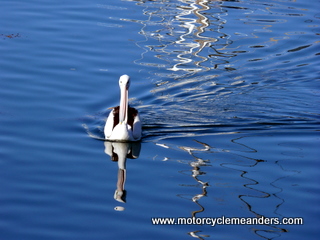
I later thought of The Picture of Dorian Gray – a novel by Oscar Wilde. You might recall that, as Dorian pursued his life of debauchery, he retained his youthful beauty, while a portrait of him, originally capturing that beauty, slowly manifested the traits of his lifestyle. It was all part of a pact he had made with the Devil. He would stay young and beautiful; whereas the picture would deteriorate into the ugliness that his vices would otherwise have rendered on him. Perhaps, the object of my passing admiration wasn’t quite in Dorian Gray’s league, but, with a little imagination, I could see that young, beautiful face, her nicely formed nose and her perfect lips, taking on all the vestiges of I moved my attention to the peace and serenity that a pelican exuded as it skated blithely and artistically across the calm waters of Lakes Entrance.
|
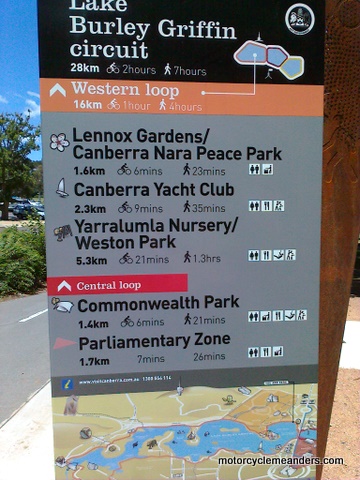 inform local and out-of-town visitors about distances and time it would take to cycle and walk the various distances. The signs aren’t for the serious cyclists or runners; they all have their on-board computers telling them everything. Mostly, the signs are informative and helpful. But I couldn’t help wondering about some of the results.
 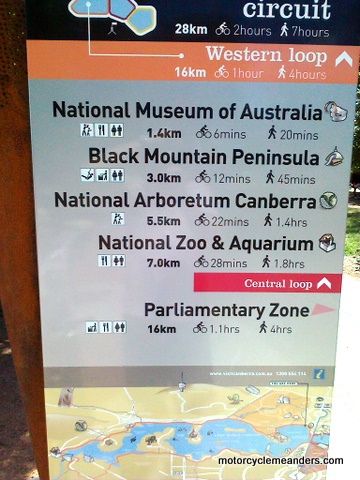 I wonder who came up with such a concept...unless there really is a secret government plan to take us to metric time. The calculations would be a breeze if there were 100 minutes in every hour!
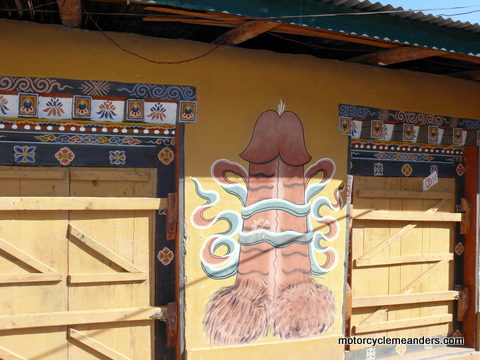 Mostly they were painted on walls of houses or other establishments. Sometimes, one might open a pull-string closed bag, out of curiosity, only to find a metal or wooden phallus fall out into one’s hand.
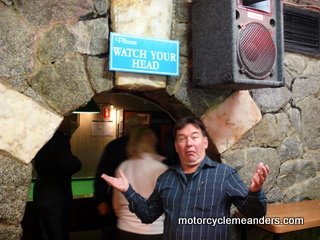 of stature. There are advantages to being height-challenged.
  To cater for the average height of 21st century patrons, warning signs remind you of the restrictions to be encountered. Luckily, for some, all this simply passes over their head!
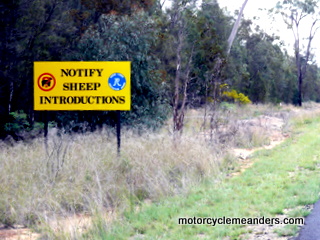 I spotted this sign on the Bruxner Hwy in far north NSW between the border town of Texas and Yetman.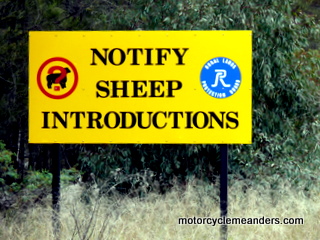
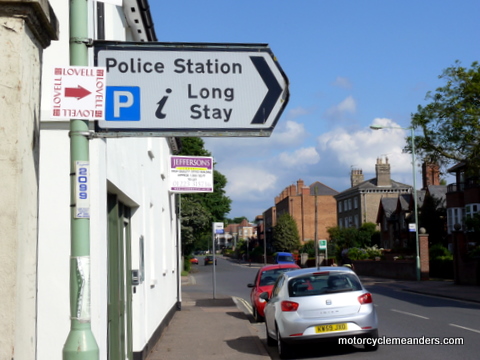 This sign is in the Suffolk town of Newmarket in the UK. I don’t think Newmarket has any particular criminal problems. It’s a horse racing centre surrounded by magnificent stud properties, owned largely by sheiks from the Gulf States. Almost in the centre of town is the enormous ‘Newmarket Heath’ – a huge expanse of gently graded grass land, owned and meticulously manicured by the Jockey Club. It’s where race horse training takes place; where stable staff ‘ride out’ every day.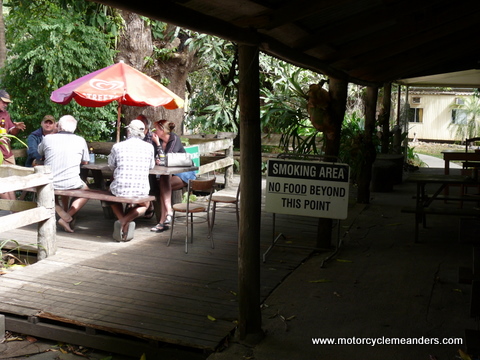
 I’m sure a lot of you have agonised over this conundrum. Most, undoubtedly, assume the answer from their religious, theist, atheist, creationist or evolutionist beliefs.
 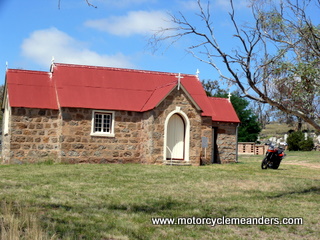 (temporarily), Heaven or Hell (both permanently). Then, with a stroke of the pen, the Vatican ‘abolished’ Limbo. Apart from the inconvenience of the word having become commonplace in the English language (and is still used despite the Vatican edict), one has to wonder what happened to all those souls who were confined to Limbo over so many centuries. Were they shunted off to cross the River Styx in make-shift refugee boats?
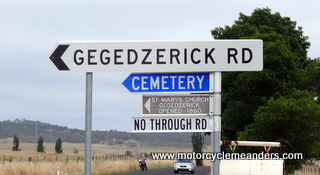 Well, I guess it’s obvious from the sign in the picture.
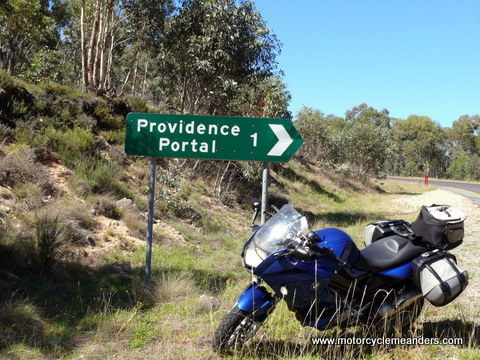 You don’t have to end it all at Berridale Cemetery.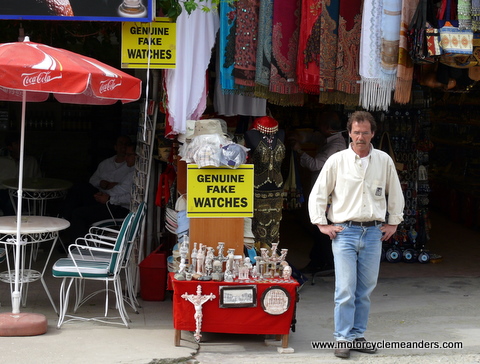
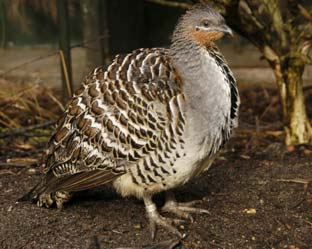 There are large areas in western NSW and Victoria that have been declared nature reserves in an effort to preserve the species.
 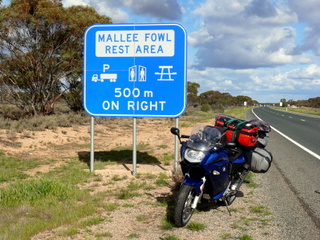 The Rest Area, of course, is one of hundreds along main highways to encourage drivers to take a break and to provide facilities for all travellers. But the announcement of a Mallee Fowl Rest Area conjured up a whole new image. Would there be artificial mounds to encourage the Mallee Fowl to breed? Or just water and seeds for snacks during a stop-over on their way somewhere? I wasn’t all that surprised not to find any Mallee Fowl at all; just a couple of motor homes and a few grey nomads.
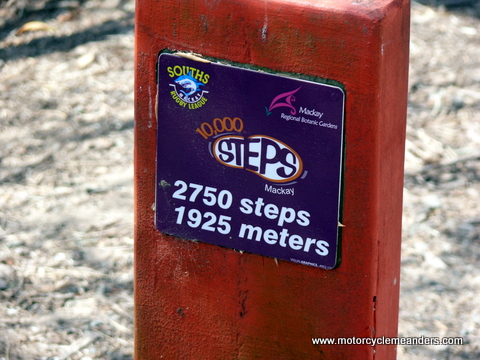 With all the attention being given to combating climate change; and the market effectiveness of an emissions trading scheme, the role of meters must surely be recognised as a vital and essential component in any climate change response scenario involving emissions measurement.
  house, with its open sides and high thatched roof – a tribute to the significant contribution to the development of the area made by Pacific Islanders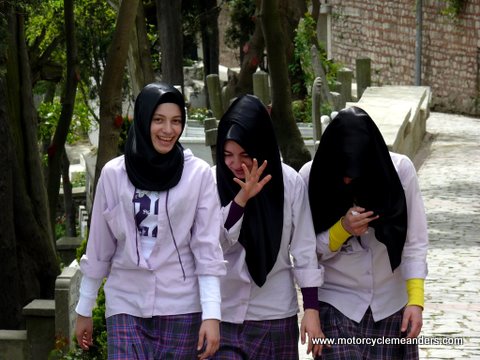
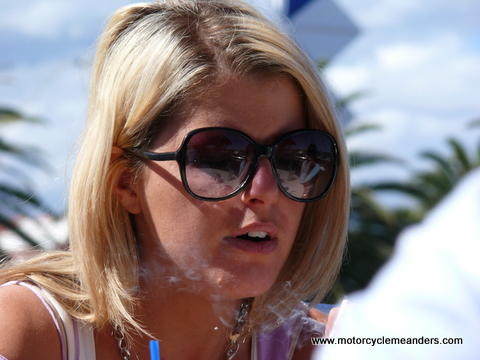 This photo was taken at Lakes Entrance, Victoria, in March 2007. I was on the BMW TourenSport Safari; and enjoying lunch on the pier with my friends from Brisbane, Paul and Viki, from the Rajasthan tour, and Joe and Marg, whom I met on the Safari. This beautiful, young lady was enjoying a glass of wine with a friend on a nearby table.
  the nicotine-laden smoke that had just wafted from her half-open mouth and her slowing exhaling nostrils. If you look carefully, you can see the look of disbelief on her companion, reflected in her sunglasses, as she (the companion) helplessly watches – possibly reminded of Dorian Gray!